Thursday, February 19, 2015

Put the "W" Right Here

In the spirit of writing at least as often on non-political topics as on political ones, this brief piece is an appeal to the hardest-working types out there, who are seldom as accurate as their title of "forecaster" would lead you to believe, but who continue to tilt at the windmill of accuracy the best their data will allow them.

I refer, of course, to the weather people on the news.

I gladly concede that they try their best every day, and deal with the data given them.  No, in fact this has nothing to do with how good they are at forecasting, and everything to do with the presentation of what they tell us.

As the capabilities of the National Weather Service and the Weather Channel and all the other trackers and compilers of weather data get better, there is a compulsion to share all that with us.  Accordingly, a typical weather segment on the news is likely to have maps on the screen that show us not only the current temperature, but also "wind chill", dew points and even changes-in-temperature-over-time.

But there's one little problem there.  They all look the same!

They have to look the same; they're all measured in the same units, i.e., degrees on the old Fahrenheit scale.  If you look at a weather map with a bunch of numbers on it in different areas, you're going to assume it is showing actual temperature, now or later.  Of course, it could be wind chill, or dew points or delta-temperature; you have to look at the caption to figure that out.  That means you have to find the caption first, of course; it might be on top, it might be on the bottom.  It might not even be there at all. And by the time you look at the caption, the map has changed.

This has annoyed me for a long time, especially in winter, when all I care about is the $%^@$ temperature.  So naturally, I have a solution.

Let's restate the problem: weather maps with numbers measured in degrees all look the same, and are on the screen too briefly to find the caption, interpret it and then go back to our own geographical area to consider what's there.  We can't change the time; we can't really change the metrics.  We can, however, very easily change the presentation.

My proposal is simple.  When a weather map is displaying actual temperature, put up the numbers the same as always, and we slugs in the TV audience will infer that it is showing "current temperature."  When it is displaying anything else, just put a character right after every number on the map, at half the font size, that immediately indicates what it is.

For example -- let's say we're doing a map of wind chill.  Suppose the wind chill is 24 in Washington, 12 in Boston and -7 in Caribou, Maine.  Instead of showing "24", "12" and "-7" and confusing the viewer, put "24w" over the nation's capital, "12w" over Beantown and "-7w" over Caribou.  There would be no need to look for a caption; the viewer will immediately realize those are wind chills and get, pun intended, the drift.


In the same manner, a map full of numbers like "64d" and "70d" and "57d" will instantly be interpreted as showing dew points, as if anyone cared.  If the map is showing, say change in temperature over the last 24 hours, just put an up or down arrow, the same size as the numerals, next to them to indicate both the increase or decrease in temperature and the fact that this is a delta-temperature map!

Check out the map above.  Isn't it immediately obvious that this is something other than a straight temperature map?  Wouldn't you be able to keep your eyes on the map because it is clearly wind chills?  I would certainly think that the Weather Channel might actually want to do something like this.

Just give me a tiny bit of the credit.

Copyright 2015 by Robert Sutton  

Wednesday, February 18, 2015

Grapes Without Wrath

Back when I was in college, some campus organization called the Lecture Series Committee (LSC) would show weekly, fifty-cent-admission movies, in a large lecture hall.  Mostly they were close-to-first-run recent flicks, with a classic thrown in every once in a while.  Students would laugh or cry, the movie would end, and everyone would leave when the credits rolled.

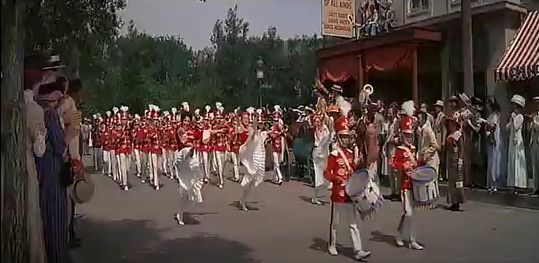
On one occasion, though, maybe around 1970, they showed the 1962 movie version of "The Music Man", the great story of the con man who comes to a small town in Iowa in 1912 to sell band instruments and falls in love, that sort of thing.  We've all seen it; it's a classic now but back then was only a few years past its release.

Among the stars are the four members of the School Board, played by the members of the Buffalo Bills barbershop quartet.  They're the four whom the con man keeps distracting by getting them to sing every time they confront him asking for his "credentials."

For this showing at M.I.T., the lecture hall was packed, with standing students all around.  Admittedly, it was winter in Cambridge, not much else to do except study, but it was really jammed.  Lots of laughter, lots of fun ... then the credits ran.

And no one left!

Four or five hundred college kids, who by this time were usually heading for the exits, stayed in their seats and actually applauded the credits!  You'll recall that the final scene is this gargantuan band pouring out of the auditorium, and as they march down the main street, all the main characters join in the parade.  For the credits, the actors' names show on the movie screen as each star marches along ... Robert Preston, Shirley Jones, on down the line.  The kids in the lecture hall applauded vigorously as each one was seen ...  Paul Ford ... Hermione Gingold ... Buddy Hackett ...


Then came the School Board, among the paraders.  And when the name "The Buffalo Bills" appeared on the screen, the movie audience stood up!  I will never, ever forget that.  Amidst the applause, itself unusual for an LSC movie, or maybe any movie, what got everyone even more roused, enough for a standing ovation, was a barbershop quartet.

- - -
I recall that moment today as I remember a gentleman named Dick Grapes of North Tonowanda, NY.  That name will probably not ring a lot of bells for you; he was not in that movie, nor did he go to M.I.T.  But Dick Grapes was certainly part of the story.

Barbershop quartet music is simply phenomenal when done well (and execrable when done poorly).  The Buffalo Bills, who started in the late 1940s in Buffalo, New York, were indeed phenomenal, enough to have won the international championship of barbershop quartet singing in 1950.  The winning group consisted of Vern Reed, Al Shea, Bill Spangenberg -- and Dick Grapes.
The BuffaloBills OC Cash
Buffalo Bills, 1950 (from left: Vern Reed (tenor), Al Shea
(lead), Dick Grapes (baritone), Bill Spangenberg (bass)

The four were not professional singers; Shea was a cop; Reed a boys' club executive and Spangenberg a truck driver.  Fortunately, their jobs allowed them flexibility to comply with their heavy singing schedule.  But when the opportunity to move to New York City and be the quartet in the Broadway version of the Music Man came up in 1956, they decided that either all four would go together -- or the quartet would not go.

Dick Grapes had a very good job in sales.  When the Bills won the audition, he determined that he simply could not take the risk and go to New York.  However, he argued sternly that the group should indeed pursue the opportunity with a replacement -- which, to our everlasting joy, they did.  Fifty years later, I was privileged to meet Mr. Grapes, then in his eighties, as he emceed a contest and regaled the 10,000 fascinated attendees with Buffalo Bills stories.  What a gentleman I met, a great story-teller but the same warm, kind individual who decades earlier had pressed his friends to succeed even when he could not join them.

It is an interesting aside that these days, the mention of the name "Buffalo Bills" is far more likely to evoke thoughts of the NFL team of that name.  That has more relevance to this story than you might think -- for many years, the older gentleman manning the down marker at the Bills home games was none other than Dick Grapes himself.

Bill Spangenberg died, sadly, in 1963 shortly after the release of the movie version, Al Shea in 1968.  Vern Reed, the little tenor with the dark-rimmed glasses, passed away in 1992, Scotty Ward, who was the substitute baritone who joined the School Board for the Broadway and movie versions, left us in 1988.

This past Sunday, Dick Grapes passed away, a few weeks after his 90th birthday.  The last of the Buffalo Bills is gone, but they're reunited where the angels can hear how it's really done.  Kind o' like this.

Copyright 2015 by Robert Sutton

Tuesday, February 17, 2015

What Did the Kids Know and When Did They Know It?

Last week, the 2014 champions of the Little League for the United States, the "Jackie Robinson West" team based in Chicago, was stripped of its title.  The team, made up of young black players 11-13, had been determined to have been put together far afield of the rules, pulling in all-star players from beyond the boundaries within which it was permitted to have its players reside.

Naturally, given the racial composition, the race industry, led by good old Jesse Jackson (asking "Is this about boundaries or race?"), rose in protest.  They complained that there was a racial component to the title strippage (though they're careful not to name one individual to call "racist"), that it was terribly unfair, that these kids had been singled out -- and one other little element.

The kids, all seem to say, are pure as the driven snow in all this; they didn't know; it was the adults who did this, the kids were innocent and should keep their title, la la la.

Here's the problem: I don't believe it.

I played Little League 50 years ago.  I still remember my batting average (.294) and many of the at-bats I had.  I remember my coach's name and many of the players.

And I remember even in 1962 that you had to live in the proper area in order to be eligible to play in that particular league.  If you lived over there, you were in that other league.  So it is, is how it has ever been.  And I was 11.  I wasn't one of those adults running the league; my father didn't coach; my family had nothing to do with the administration of the league -- we just played ball.

And we knew there were residency rules to follow.

There is little doubt that the players on the team representing the now-disgraced Jackie Robinson West organization were aware that something was amiss.  How could they not be?  If you know the community where your league can be pulled from, and all of a sudden other kids you didn't know a week earlier start playing third base and center field for your team, you have to know.

They're 11-13 years old, they're not four.  They know quite well that something has changed and, I assure you, they have a sense of whether it was right or wrong.  They aren't stupid.  Look at the article; team officials were going to neighboring leagues to "convince them to go along."  The kids knew something was up.

Now, I don't "blame" the kids, at least not a lot.  What were they supposed to do, call the cops?  In Chicago?  But stop the whole blathering about innocent children.  They weren't complicit in the actual corruption; they didn't cause it, but they certainly were aware that the organization was playing fast and loose with the rules, loading their team with talent.

Nothing about this whole effort was good.  Kids had to be embarrassed in front of the country.  Adults screwed up royally and caused those kids to be embarrassed.  "Clean" players from the second-place team were permanently denied the chance to play for the Little League World Championship.  The shameless race-baiters are out again spouting their stupidity.

Just stop with the "innocent children" stuff.  They knew.

Copyright 2015 by Robert Sutton

Monday, February 16, 2015

Crusader Rabbit-Hole

Last week at the National Prayer Breakfast, our esteemed president jammed his foot in his mouth again, this time intentionally.  In trying to defend Islamic terrorists, a term he still won't use for no apparent reason, he made the following inane remark (it's about the three-minute point, but you've heard it):

"Lest we get on our high horse and think this is unique to some other place, remember that during the Crusades and the Inquisition, people committed terrible deeds in the name of Christ. In our home country, slavery and Jim Crow all too often was justified in the name of Christ."

Of course, despite his protestations of being a Christian, and spending 20 years in the flock of that great American, Jeremiah Wright, he never learned that the name "Christ" has a "T" at the end; for some reason he kept saying "Chrise."  Listen to the recording; I'm not kidding.  He does it twice, it was obviously intentional.  Who does that?

But I digress.

Obama missed the point of the comparison that he himself gave.  Anti-Islamic-terrorist advocates, whether Christians, Muslims, Jews, Buddhists and whatever else, do not have to apologize for what happened in the name of their respective faith.

Because, and here's the point -- if the evils ascribed to the Crusades and the Inquisition happened today, we would condemn them with the same fervor that we condemn the acts of radical Islamist terror today! 

Obama's stupid "two wrongs make a right, or at least they prevent us from calling one wrong" comparison forgets that very thing.  The moral code under which the world operates in 2015 would call comparable actions to the worst of the Crusades evil, or at least something to be stopped -- same as Islamic terrorism is.  Today's world would have fought the Inquisition, and today's world needs to stop Islamic terror.

It bedevils most Americans that their president would take the discussion down a rabbit-hole, by making such a confusing and inappropriate analogy -- let's face it, he's saying that today's Islamic terrorists are no worse than medieval Christian inquisitors were and therefore should not be vigorously condemned -- what else can he possibly have been trying to say?  It bedevils us because the actions of medievals in a completely different society have not for centuries been thought of as "good" or "justifiable."

The actions of Islamic terrorists today must be measured not against the morality of the Middle Ages but against what we in 2015 -- and for at least a few centuries -- think of as right and wrong.  Seriously, do you think you could find a minister or priest of any Christian denomination who would defend the promotion of Christian values by war and murdering "infidels"?

Let us not fall into the trap of responding to Obama's words by debating his premise and defending Middle Ages Christians.  His rabbit-hole of Crusaders leads us to a comparison that is flawed and, I contend, intentionally so.

For what purpose, we can only guess.  And none of the guesses are pleasant when you're analyzing a guy who can't even pronounce "Christ."

Copyright 2015 by Robert Sutton

Friday, February 13, 2015

Calling All Grubers

As we are all aware, the disaster of a health insurance law we like to call "Obamacare" is facing a critical challenge to its existence in the Supreme Court shortly.

One of the 55,765 provisions in it (those cherries that Nancy Pelosi told us we'd have to pass the law to find out about) concerns the payments made by the Federal government, by which we mean "the taxpayer", to people below a certain income level to "help them with the payments."  The rest of us call that "income redistribution", by the way.

Those payments have to pass two barriers.  First, there is an income test; to receive money you have to be below a certain income level.  Second, and herein lies the rub, is that such payments can only be made, according to the law, to people living where there is an exchange [i.e., a health insurance marketplace] established by the State."

If you have read this far, you are of course aware of the legal challenge and its ramifications.  Some states have established their own exchanges as the law wanted -- but did not mandate them to create.  So we have states with exchanges and others without.  If the law makes the Treasury send checks to people in one state but not another, the infrastructure of the law will collapse.

So of course, the Administration is screaming that no, no, when the law was written the term "State" was meant to be "government" and, barring that, the law's direction for the HHS Secretary to establish exchanges for the non-compliant states makes them "established by the State" and, if that doesn't work, then gee, we can't have a whole bunch of the poor lose their insurance, can we (even though they didn't have it two years ago, and the Court can not take into account the impact of a ruling anyway; that's not what the Supreme Court does).

If I'm on the Court (and no one has threatened to put me there), I care about two things.  First, does the content of the law violate the Constitution?  Second, does the specific case (King v. Burwell) carry a misinterpretation or, conversely, a correct interpretation of Congress's intent in drafting the law?

Well, there's no doubt the Obamacare law is sufficiently constitutional as far as this case goes.  One could argue, in a separate case, as the Supreme Court has upheld the validity of the law only because the penalty for lack of insurance is actually a tax, and tax bills must originate in the House, not the Senate, that the passing of the law via budget reconciliation violated the Constitution.  However, King v. Burwell does not speak to that.  

No, the issue is intent, and on that there appears to be some doubt, depending on whom you talk to.  What is being asked is simply that, in Section 1311 of the law, where it reads "... and which were enrolled ... through an Exchange established by the State under 1311 ...", did Congress intend that "established by the State" referred to one of the 50 States?

So if I am Justice Sutton of the Supreme Court, I would be immediately on the phone to the U.S. Marshals Service asking them to round up one Jonathan Gruber, professor of economics at M.I.T., hand him a subpoena, and tell him to get his pompous butt to Washington -- now. I will ask him one question:  "Mr. Gruber, you are under oath, and the penalty for perjury is pretty bloody heavy when you lie to the Supreme Court.  Did Section 1311 of the law intend to refer to exchanges that were established by individual States, and is that provision, as you have stated before, in the law as a lever to force the States to comply?"

Mr. Gruber has stated his role in the development of the law many times.  It may be that no one knows the genesis of it any better.  Certainly no one else has claimed any more responsibility (we would say "blame") for its specific content, and the issues that appeared in its drafting, than Mr. Gruber.

Come on down, Jonathan Gruber, and tell the world under oath, at the risk of perjury and loss of tenure at my alma mater, exactly what that provision was intended to say.

I think that we all know what the correct answer is, and so does he.  Come on, SCOTUS, give him a call.

Copyright 2015 by Robert Sutton

Thursday, February 12, 2015

In Praise of Laugh Tracks

I've been thinking about this for a long time and, yes, I do think about stupid, pointless things as well as deep, metaphysical ones.  Yes, the former trump the latter.

A long, long time ago, when Lucille Ball and Desi Arnaz and Jackie Gleason and John Forsythe and Bob Cummings showed up live on our 12" TV screens, the shows were live, there was an audience in the studio and when someone said something funny (or forgot their lines), the audience laughed.  In our living rooms in front of those little screens, we laughed along with them, and the actors vamped and waited politely until they could be heard.

That's the model we grew up on, the same as in Shakespeare's day (and he had some whoppers in a few of those plays) sans TV sets, and the same as today in live performances like comedy clubs and Broadway musicals.  They make funny, we laugh, and the timing is reset for the next line.

The only place that there is dead silence after a joke is in the movies, where there is no live audience and everyone in the movie studio is sworn to dead silence.  It has always been, at least to me, one of the distractors in film (the element that stops suspending my disbelief) that something funny happens and no one laughs.

It used to be the only place.  Some time in the recent past, some TV comedy, and I can't recall which, decided to omit the laugh track.  While other sitcoms proudly had one of their actors do a voice-over that "[Name of Hilarious Sitcom] is [filmed/videotaped/recorded] before a live audience" and raucous laughter accompanied the jokes, this one blazed a trail of silence, as if we were sitting in an empty theater.  Perhaps it was M*A*S*H; I know they took out the laughter in the OR scenes.

I plainly recall my first thought, which was "something's not right here", followed by "they turned off the laugh track", followed by "what were they thinking."  After a while, I started thinking something less pleasant, that is, that there is a whole lot of pretentious crap going on, if a stinking TV comedy is trying to get us to believe we're in a movie theater.

That was really what bothered me, the apparent smug self-importance of the people making decisions to believe that a TV comedy was too important to have laughter heard -- and no one is more smugly self-important than Alan Alda, the show's "creative consultant" and one of its lead actors. 

At any rate, now we have a bunch of TV sitcoms without laughing, from Modern Family to well, this one and that one; I've gotten so used to being unsurprised at the device that I forget which ones do and which don't.  I do know that I'm a lot more comfortable laughing with "friends" and sharing the humor not only with my lovely missus, but with the chuckles of the other unseen chucklers on TV confirming our taste in humor.

I hate that kind of pretense; I just know that the laugh tracks were pulled from those shows because some artiste thought the laughter to be beneath them (who knows, maybe it was theater girl all grown up who made it to TV).

I'll bet I have friends who just detest laugh tracks and wish they'd all go away, and they're just as entitled to their opinions as I am.  But I wrote it first, neener neener neener.

Make 'em laugh.

Copyright 2015 by Robert Sutton

Wednesday, February 11, 2015

What If Kanye West Complained and No One Listened?

It will be no surprise that my lady and I did not watch the Grammy Award ceremony on TV this past Sunday night.  I pretty much do not know who any of the performers are, I certainly don't know any of the songs or albums that were nominated, and I'm not much of a fan of award shows where an industry pats itself on the back for merely existing.  Meh.

However, the networks and the major websites have an obligation to feed the insatiable appetite of their audiences.  So for one news cycle of maybe 37 hours and 15 minutes, they talked incessantly about what happened at the awards ceremony.  This is typically confined to which celebrity wore the most (or least) outrageous attire on the Red Carpet; which celebrity wore the most wonderful (or worst) attire on the Red Carpet; which celebrity showed the most (or least) of their anatomy on the Red Carpet.  You know, that sort of thing.

Rarely is there much flap about who actually, you know, won the awards; certainly not as compared to the Who Wore What (and, among the cognoscenti, Who Wore Whom) topics.  There is, however, occasional flap about someone doing something or saying something on stage.

Now, let's understand that this is a classic FTM situation, and we follow the money by seeing who has something to sell.  And that someone appears more often than average to be Kanye West, who is apparently some kind of performer, married to the equally-talented Kim Kardashian.  A few years ago, West was apparently incensed because the performer Taylor Swift had won some kind of award at some kind of awards show that West thought would have been better presented to someone else.  He interrupted the presentation, then figuratively (or maybe literally) grabbed the mic, and sounded off in the middle of the ceremony about how the award should have gone to whomever his favorite was.

On Sunday, good old West was at it again.  According to the next day's screaming headlines, some one-named performer I was not familiar with won a Grammy in some category.  As it was being presented, West ran partially up on stage as if to parody his own rudeness of the past, stopped in mid-offense and returned to his seat.  The Actual Winner stopped and repeatedly called him back up, presumably knowing that giving West the mic again would make for better drama, but to no avail.

However, after it was all over, to no one's surprise, someone did a brief interview with West and his equally-talented wife.  West complained that Beyoncé Knowles, rather than the actual winner, should have gotten that particular Grammy.  His actual words were "... if the Grammys want real artists [sic] to keep coming back, they need to stop playing with us [sic]. We ain't gonna play with them no more [sic]. Beck [apparently the name of the winner] needs to respect artistry and he should have given his award to Beyoncé, and at this point, we [sic] tired of it."

He didn't exactly explain who "they" are (the 2nd and 3rd "sic") nor who "we" are (the 2nd, 3rd and 4th "sic") and I really don't know.  My guess is that by "we" he either meant black people (e.g., he and Miss Knowles), since the two winners he didn't like were white, or "real artists", by which, well, I have no idea what he meant.  In fact, I'm having a hard time caring enough to finish this piece.

But yes, I have a point.

After his illiterate rant above, West followed with ... "We not playing [sic] with them anymore.  And by the way, I got my wife, I got my daughter and I got my clothing line (italics mine).

And there, friends, is where the old FTM rule made itself intensely clear.  Kanye West couldn't possibly care less who wins the Grammy for, well, whatever they didn't give the Grammy award to the person whom he says should have gotten the Grammy award.  No, this literary genius and his equally-talented wife have a clothing line, and by making all too sure that the topic of his clothing line showed up in the classless rant during and after the ceremony, we would theoretically remember his clothing line.

So here goes.  Kanye West, whoever you are, let me suggest a better solution.  I put a link to your clothing line right here, so that people with great taste in essay-writing will know exactly where to go to find your clothing line, and can spare you having to embarrass yourself and your equally-talented wife by doing stupid things at awards ceremonies.

There.  Everyone can now find your products.  Just sit back and enjoy the show from now on.

Copyright 2015 by Robert Sutton

Tuesday, February 10, 2015

Syringes Up -- Don't Shoot!

In what must have been a slow news week last week, the flap du jour had to do with, of all things, vaccination of children against diseases for which we have actual vaccines that can actually prevent disease.

The only -- and I mean only reason that it got to the level of being a news item was because of comments made by New Jersey's governor, Chris Christie, in England where he was asked about mandatory vaccination and remarked that parents had a role in deciding in certain cases when children should be vaccinated.

Since Christie may be running for president in a year, it is imperative that the press find ways to damage him.  His words were a bit muted -- "Mary Pat and I have had our children vaccinated and we think that it’s an important part of being sure we protect their health and the public health ... I also understand that parents need to have some measure of choice in things as well, so that’s the balance that [the] government has to decide."  However, that gave the press plenty of ammunition to jump on him.

So gee, what's the right answer?  If you properly parse the governor's full text, he seemed to be saying that for many diseases, the combination of severity of the disease, availability of the vaccine and minimal risk of adverse consequences makes it right for the government to mandate vaccination.  He suggested that for others, parents should or could have input.

Unfortunately, his having said anything at all distracts from the discussion -- what he said is less important than the broader issue -- shall government ever mandate vaccination for any disease and, then, what is the process for determining which diseases and vaccines are to be on the mandate list?

Way back in September when I started writing, one of my very first pieces was this one, in which I explained that "moderate" was a terrible name for people who had a few views on issues that conflicted with their basic tendency toward conservatism or liberalism.  I suspect my belief here will not track so well with some who agree with my points on other unrelated issues.

I say "Give the kid the shot."

I say that -- and I also say that Government mandates are necessary -- because it is within the Federal and state governments' jurisdiction to protect the health and welfare of the citizens.  Now, I neither trust the Federal Government to make any decisions regarding the education of children, nor believe it is in its constitutional authority to do so, but health and welfare is a different topic.

We legitimately expect the Federal Government to research threats to the health of its citizens and promote (but not dominate) research into prevention and cure of those threats.

I consider it a public threat to the health of my children if they are in school with an unvaccinated peer.  I especially get worked up if that unvaccinated peer is in the USA illegally, but that's another topic.  If, through whatever legal process in place, a vaccine is mandated for use on all children of a certain age, then not vaccinating that peer is a criminal threat to the well-being of the community.

I also contend that, once approved for mandatory use, the manufacturer of such a vaccine should be insulated against lawsuit for adverse effects not connected to improper manufacturing process.

This is going to stir up a few folks, but there certainly should be a national policy on immunizing children, and that policy should be that a list of vaccines proven safe and effective against contagious illnesses be developed and continually updated.  All children shall be vaccinated in accordance with the list and their parent or guardian subject to Federal penalty if not.

And above all, the law shall mandate that unvaccinated children illegally in the USA shall be immediately vaccinated and then subject to deportation depending on their status under the current law (that's "law", not "executive order").  None of us can possibly think we can safely ignore the health threat of the tens of thousands of unvaccinated illegals flooding the USA.

Give your kids the shot.

Copyright 2015 by Robert Sutton

Monday, February 9, 2015

The Cubbyhole Theory of Maturity

As I write this, at 63 years old, I feel comfortable saying that I can see into the future.

No, I'm not telling you that I'm psychic or anything like that.  I simply believe that I have a good sense of the future impact of things that I do.  I would feel fine about taking actions, or avoiding actions, knowing that the likeliest outcomes of them would be positive, negative or whatever.

Now, that has nothing to do with me, per se, but with my age.

Think of it this way: a three-year-old does nothing but try things all day.  He has very little idea of what will happen afterwards and can visualize almost nothing that may result if, say, he jumps up and down on the bed, or runs with scissors, or tries to fly out the window.  He has essentially experienced nothing.

The capacity to anticipate the consequences of your actions expands as you get older.  A ten-year-old might be able to figure what will happen a few hours or a day after he does something; a high school student maybe a week.  Anything past that is beyond his event horizon and he is not so much prepared regardless of what happens then, but oblivious and unconcerned.

By 30, of course, humans have matured to the point of being able to make decisions that will have ramifications a year out, and it goes up from there.  I can't tell you that I know what will happen ten years from now, but I can visualize alternatives and likely outcomes.

I believe that there is a tangible way to look at this, and for that I use the metaphor of cubbyholes.

A long time ago, when I first started thinking about what "maturity" really meant, I considered things like sanity, like dealing with others, like values.  However, that seemed too vaporous a concept, and I needed something better.

Eventually I realized that the whole concept of "visualizing consequences" was core to defining maturity, and that the key was determining what gave us the ability to foresee those consequences.  It's actually pretty simple once you think about it.  We are able to foresee more likely outcomes as we get older, because we have seen the triggering actions before and remember what happened thereafter.

So think of a human's mind as an ever-increasing set of cubbyholes into which actions and outcomes, paired together, reside.  Every time we observe an action and reaction or consequence, and connect the two by cause and effect, our brain creates a new, referenceable cubbyhole with the relationship in it.  By the time you get to be, say, 40, you have seen a lot of things and have thousands of cubbyholes in that dusty old brain of yours -- and the number keeps expanding.

Eventually I have come to realize that what we call "maturity" is simply, stated another way, "counting cubbyholes".  The Founding Fathers didn't stick that age-35 minimum to be President in the Constitution for nothing; they knew instinctively that you needed a brain stuffed with more than 35 years of cubbyholes to be able to handle everything that came at you, the more the better.

We reach into one of those cubbyholes (and chuckle) when our little children make an excuse that we ourselves made many years ago.  Something in one of those cubbyholes tells us that a doctor in Nigeria is not actually ready to send us $1 million if we'll just give him our bank account number.  Another tells us that no, Sports Illustrated is not serious when they say their swimsuit issue is actually "sports."  And another told us that Obamacare was not a really good idea -- well, the Democrats in Congress had that cubbyhole, too; they just ignored it.

Of course, one of the cubbyholes is a special one, and that's the one that understands what I just wrote.  We've possibly heard the story of how an aide to an early 20th Century French president, Clemençeau if I recall correctly, burst into his office to tell the president that his son had joined the Communist Party.  Clemençeau replied calmly, "If he had not joined the Communists by the time he was 20, I would have disowned him.  If he is still a Communist at 30, I will disown him then."

Get it?  That special cubbyhole is the one where you discover that you don't know everything, and that pretty much everything you've thought of as a great idea has been thought of 166,754 times before (and mostly failed).  When you get that cubbyhole, your parents suddenly get a whole lot smarter than they used to be.

And you realize that what you're learning as you get older is a whole bunch of "if-then" relationships that make us wise ... and mature.

Copyright 2015 by Robert Sutton

Friday, February 6, 2015

Thanking Those Who Took the Chance

The Obama Administration and its defenders have been on a six-year crusade to defame American business, and deny its function in American society as the primary creator of employment for the rest of us.  The president himself has made stupid remarks like "You didn't build that", while the next Democrat expected to run for the presidency, Hillary Clinton, made pretty much the same absurd statement -- "Don't let anybody tell you that it's corporations and businesses that create jobs", which is an all-time head-scratcher.

I do know that for all of my life, I would never have had a single job, had not an entrepreneur taken the chance and made an investment that provided growth (and not always success) for them and a job for people like me.

That includes the different people who threw together a landscape company, a bowling alley and a woodworking shop that provided me employment between college semesters.  It includes, in no particular order, people like the late Bob LaRose, the vision behind the company ATI and others later; Jesse Surles, the founder of the CPA firm for which I was the head of MIS in the 1980s; and the Malhotras, who created VMD, employing over 100 people last I looked.

It also includes some visionaries of the distant past, the founders of the Singer Company, Northrop Aviation, the Burroughs Corp., Grumman Aviation and others whose risks of decades past created immense firms providing employment for hundreds of thousands of Americans.  At the other end of the size scale, it includes my wife and me, who started two companies in the past 35 years which provided over a dozen jobs.

These people -- even the two of us -- represent the scale and scope of American business, taking risks that clicked and risks that failed.  By taking those risks to create value in products and services and growing demand for them, entrepreneurs have opened hundreds of millions of jobs for hundreds of millions of Americans -- even those not here legally.

So why is the Administration, aided by its associated Hillarys, blocking them?  Why do they take the extraordinary step of denying what the rest of us can see, that the American economy is built on entrepreneurship and leadership, and its success relies upon the capacity of risk-takers to create markets and hire the talent needed to bring them to fruition.

They do so because, friends, they're socialists, and they want it all without working for it.  To concede a fraction of an inch to the success of the economy of the USA, they have to step away from their notion that all capital innately belongs to the Government; that all rights ultimately default to the Government; and that all good derives only from the Government.  It takes, as Mrs. Clinton tries to insist, "a village", and that village is that benevolent one in Washington.  That's the one that has me paying for dental insurance for children I don't have.

As I look back on my professional life and the odd variety of firms which have paid me a salary for services rendered, I see that, in every case, the position traced its creation back to an individual willing to take the risk and apply the vision needed to create a company capable of engaging employees.  The USA looks up to these people; I look up to them for their success and appreciate what their efforts produced.

I also appreciate that the Government, at least prior to this administration, facilitated an environment in which they could create and grow, by doing what Government is supposed to do.  It defended our shores to protect our existence and out livelihood.  It oversaw interstate commerce to ensure a fair playing field.  It developed and defended the medium of currency within which we operate.

But the Government didn't build the economy, and it creates employment only at a cost to the rest of us. 

It is the entrepreneur whose creations produce economic growth, and whose risk-taking and investment and perseverance I salute today.

Yes -- you did build that and, yes, you did create jobs.  For that, I thank you.

Copyright 2015 by Robert Sutton

Thursday, February 5, 2015

It's Not Execution, It's Murder

What to call it?

The ongoing saga of Islamic terrorism and its actions -- and victims -- practically screams for an honest characterization of its actions and the responses to it.  So here is my appeal to the national and international networks.

Please clean up your words.

When a person dies at the hands of another, the circumstances, not the media, dictate the appropriate word for what happens.  Sometimes it is an accident; sometimes it is intentional  Sometimes it is to make a point; sometimes it is retribution.  Sometimes when it is retribution, it is just -- and sometimes it is not.

There are actually words for those instances, and the media need to start using them properly.  The two that the media actually need to use most properly are "execution" and "murder."  Hint: they're not the same thing.

The media apparently have conflated "execution" and "execution-style" into one all-purpose term and, in the process, fogged up the appropriate meaning.  So let us start by getting all the terms right:

Murder is the intentional killing of an innocent who is intended to be killed by the murderer, despite the innocent having not been convicted of a crime.  The keys are that it is extra-judicial, and that no capital crime was committed by the innocent.

Execution is the organized, official judicial punishment meted out to the perpetrator of a capital crime in accordance with some standard quid pro quo guideline after something resembling due process.

Execution-style refers to the carrying out of the taking of a life in the manner of an execution, though without judicial process of any kind -- think St. Valentine's Day massacre, done like a firing squad, as an example.

The media unfortunately have continued to use the term "execution" so haphazardly as not to realize that when they use it incorrectly, they grant the presumption of due process to cold-blooded murderers.  That is my objection, and it is sufficient to drive the need for this column -- I do not want to see terrorists granted the imprimatur of some kind of justice, when they commit cold murder.

So let us apply terms appropriately, and stop captions like this one.  The Jordanian pilot burned by ISIS terrorists was not "executed", he was a prisoner and was murdered.  The people, including the policeman, killed in the Charlie Hebdo attack were not "executed", they were innocent of capital crimes; they were not convicted in any judicial environment -- they were murdered.

The two Iraqis killed by the Jordanians in response to the burning of the Jordanian pilot had been convicted of crimes in court -- they were actually "executed" in the proper meaning of the word.

Let us please start calling murder by its proper name, and reserve the term "execution" for the carrying out of a judicial process.  That includes murders here in the USA and overseas.

ISIS has no standing to execute anyone; they are murderers and their killings need to have the proper label.  They may be performed "execution-style", but they certainly are not executions.

One hopes the media will start executing this change immediately.

Copyright 2015 by Robert Sutton

Wednesday, February 4, 2015

What Good's the Music If You Can't Hear the Words

Way back in the late 19th Century, the master librettist Sir William S. Gilbert and the wonderful composer Sir Arthur Sullivan combined on a series of 14 operettas, most of them successful and all still frequently performed worldwide.  Of course, their respective roles -- writer and composer -- caused more than their share of tension between them.

In operatic tradition, the libretto was simply a medium for the composer to produce beautiful sung performances.  Sullivan, a protege of Felix Mendelssohn, was firmly in the camp that the music was the primary reason for the composition.  Gilbert, a lawyer and brilliant satirist, wanted his words to be heard and appreciated.  While the survival and thriving of their combined works offers a lasting tribute to the talents of both, their disputes over the relative priority of each others' contributions set the stage for contention in the field, that lasts to this day.

Naturally, this piece has almost nothing whatsoever to do with Gilbert and Sullivan, and everything to do with ... yes, Grey's Anatomy. No, I don't mean the historic textbook used in medical schools, of which I owned a copy while a student at the University of North Carolina School of Medicine in 1973.  I mean the TV show.

Grey's Anatomy, as you surely know even if you've never watched, is a TV drama series set in a hospital in Seattle, with the staff and administration caught up in assorted affairs, marriages and child-producing, same as most medical dramas of the past.  The stories are interesting because medical stories invariably are interesting (hint: it's never lupus).  The dialogue is actually pretty quirky.

At least, the dialogue I can hear.

That's because, like several other shows of which Grey's is a fine example, the producers have apparently a side investment in the music industry.  Accordingly, there is a soundtrack running throughout much of the show, including during the dialogue.

In an effort, we presume, to sell lots of copies of the background music on iTunes, the volume of the background music is turned up to a decibel level comparable to that of the speaker of the dialogue.  This means that the ear of the viewer, which is trying to monitor the dialogue so as to follow the intricacies of the plot, catches many, but not all of the spoken words.  The percentage of words actually heard drops precipitously when the doctors, as they are wont to do, have surgical masks over their faces in the OR and you can't read their lips to help understand them, because the music is too $%@!&* loud.

I'm not young anymore, but my hearing is just fine (I had it checked).  And I'm not alone; just poking around Al Gore's Amazing Internet, I saw pieces (here's one) noting the same problem in passing.  Obviously the FTM principle applies here, and if you simply Follow The Money you can easily see that as long as there is some kind of vested financial relationship between the producers and some part of the music industry, this is not going to change.

But I'm going to go on record here, and let the producers know that watching Grey's Anatomy is far, far more work than it needs to be, and far, far less pleasurable an experience than it could be.  Would that they would simply drag out one of the ubiquitous focus groups, plunk them in a room, and use them to set the levels of the music low enough so that the words could be heard and understood, even behind surgical masks.

Sir William S. Gilbert would be very, very proud.  And I could finally figure out the remaining mysteries of the plot, like who's watching all the children they keep producing, when everyone is operating.

Copyright 2015 by Robert Sutton

Tuesday, February 3, 2015

Strawmen Even in Baseball Writing

Jayson Stark is a pretty good baseball writer for ESPN, prolific and with a good understanding of the game.  That is, of course, with one exception that gets trotted out every year at this time and unfortunately displays his inability to avoid "going all strawman" on his readership.

You can see the 2015 version here; and I can save you the time by telling you that it his annual rationalization that baseball has better parity than the NFL (and therefore does not require a salary cap such as exists in the NFL).  Unfortunately, he does what good writers making a case or a point should never, ever do -- he pre-defines his parameters, using those which would help to make his case.

In Stark's case, he uses a comparison of how frequently top teams make the Super Bowl (or win it) against Major League Baseball teams' propensity to make or win the World Series, neither of which involve sample sizes worthy of being used in any argument.  So let's begin ripping his article apart step by step.

Let's start with the NFL.  Stark is thrilled about the Patriots and Seahawks being in the Super Bowl because, in his words, "... they’re making this way too easy for me to expose the fiction that permeates the popular wisdom about these two sports."  That "fiction", of course, in his view, is about parity in the NFL, and that the parity is based on equivalent team salary structures (which MLB does not have, given the huge disparity between the Yankees/Dodgers and everyone else, and the number of small-market teams barely sniffing the playoffs every ten years or so).

Here's the strawman part of Stark's case -- parity is about opportunity, not about result.  Let me say that clearly: The NFL has parity, in that each team has the opportunity to build a successful franchise and a semi-dynastic, successful team, because its resources are the same as each other team.  It is a pure meritocracy.

Stark's mistake is in looking at the result, which is that the NFL is indeed dominated by a subset of its teams, without celebrating the reason for that: In the NFL, unlike MLB, sustained success is, as it should be, a function of the quality of the organization, not the ability to outbid the other teams for the best players.  I feel like Jayson Stark needs to read that sentence 50 times.  If he did, he would finally get it -- the NFL has actually succeeded at parity, where Baseball has not (and I'm a much bigger baseball fan than pro football), because sustained excellence in the NFL, measured in wins per season over years, comes from good drafting, good salary management, good trading, good field leadership -- all the things that you want to be the reasons for success!

The Patriots and Seahawks organizations, like those of consistently successful teams such as the Broncos, Packers and a few others, do all those things well -- better than their rivals -- with stable, high-quality ownership and management.  Their down years are the exception.  The Raiders, Jets, Redskins, Browns and a few others have been bottom-feeders for the same reason in reverse, while improved organizations (the Lions for one) show improvement reliably on the field.  In baseball, only a few organizations are so competent (Oakland) as to overcome their relative poverty, and only a few (Mets, Phillies) so incompetent as to negate their high payrolls.

That is what you want as the factors of success or failure, not revenues.  If the consistently winning teams in the NFL are the best organizations, then bang, you have what you want, don't mess with it.

Baseball is not like that, almost at all, but Stark uses all the wrong metrics.  If you were to sit down with no data in front of you, and ask yourself what criteria you would use to decide whether there was parity in MLB, you sure wouldn't look at World Series winners any more than you'd assess parity in the NFL primarily on Super Bowls.  The playoffs, once you get there, are a crapshoot and far too small a sample size to evaluate.

No, you would look at a solid statistical analysis of wins and losses over a long period -- 15 years or so -- for a correlation with team salaries.  You could look at team revenues, but they're the cause of the salary disparity; the disparity is actually the effect which affects the salaries and thus the composition of the team on the field, so you need to look at salaries.  In fact, I would probably look at won-loss data only from April to August, because the pennant race shapes September and there are a lot of artificial losing streaks and skewed win-loss records in September from late call-ups by teams out of the race.

Surprisingly, I don't know the answer to that correlation, because I haven't done it.  But more importantly, Jayson Stark didn't do it either and, unlike me, he was paid to write that article!  His criteria for parity are, in fact, laughable, cherry-picked for his thesis.  For example, here are all of them:

- Only two MLB teams have repeated as World Series winners in 30 years
- Only the Yankees' six WS appearances 1996-2003 constitute a streak of that kind in 50 years
- All but 6 MLB teams have made the WS in the past 30 years and 17 have won one
- 30 of the 45 MLB playoff teams the past six years had not made the playoffs the previous year
- It was 2005 the last time a majority of playoff teams repeated from the previous year
- In the last ten years, 27 of 30 MLB teams have made the playoffs
- Five of nine teams with the highest 2014 payrolls missed the playoffs; three finished last
- Of the teams with the 12 highest Opening Day payrolls, only one of them won a 2014 playoff series

Take a look at that, because that is the totality of Stark's argument as far as MLB is concerned, and none of those factors is a useful measurement of the actual influence of payroll disparity in baseball; you would not use any of them unless you had pre-decided your conclusion and looked for statistics to support it.

In other words, first, he mistakenly defines "parity" in terms of outcome (in other words, that disparity should not happen at all, and all teams should win or lose equally over time, which is not "parity").  Second, he goes searching for data to support his thesis, rather than first figuring out the data to analyze and only then making his inferences.

I challenge Stark to do that analysis of 15 years of won-loss records from April through August and correlate the data against team payrolls (dollars, not rankings).  I have no idea what answer will come out (although I strongly suspect that the Yankees' lead in payroll in all years but 2014 will correlate with lots more wins than the average opponent, and that Oakland will be the outlier in the data).

But if it comes out that there's not much correlation, I'll be the first one to say "Mr. Stark, I was wrong."  I just don't expect I'll have to.

Copyright 2015 by Robert Sutton

Monday, February 2, 2015

Plus Ça Change, Or Maybe Not So Much

In conversation recently, my younger son mentioned that a coworker of his had just returned from a trip to India, where he was originally from but had not visited in a very long time.  He and my son are both very thoughtful individuals, and as they discussed his trip, he couldn't help notice a remarkable distinction between the two societies.

Although the coworker had not been back to India for at least 15 years, it struck him that it hardly mattered whether it had been 15 years or 15 minutes -- nothing had changed.  The India of 2015 was essentially indistinguishable from the India of 2000 and, in his view, the India of 1900.

The two of them then discussed the contrast with the 2015 version of the USA -- a stark contrast, they agreed, because society here changes constantly.  And that, friends, was a remarkable insight that is worth wondering about.

I do not pretend to be very familiar with Indian society as a whole, and am not so stupid as to guess very much about it and then make inferences.  But I do wonder to what extent there is any actual incentive to change much there, particularly away from the most urban areas, and even in them.  A billion people live there.

To me, their exchange far more critically pointed out something about the USA, rather than about India, primarily because we are the country that so little resembles the other societies on earth.  Were you or I to slide into a coma and awaken ten years later here, there is no doubt that it would be into a different society from that last encountered.

I'm not even talking about things like technology, because that's too simple, but the way we apply technology.  We all carried laptops and flip-phones, then iPhones and laptops, then iPhones and tablets, and each evolution changed a dozen important things about our daily lives.  We take to some (iPhones) and reject others (Google Glass), but we do it quickly and the ones that pervade our lives do so thoroughly and immediately.

I lived through the '70s and astronomical interest rates, 15% mortgages and the like.  Inflation was terribly high, and we were all thoroughly depressed.  Mortgages are now advertised at 3% or less, and have not changed more than a point or so in many years, although the housing market is a disaster.  Banks once paid a decent rate on your savings; now you would never open a savings account with an expectation of return -- all the money goes into the stock market.

We do the same thing culturally.  Had you gone comatose in 1999, would you have assumed to wake up 15 years thereafter with the prevalence of gay marriage, interracial couples depicted all over the TV series and, at the same time, an instinctive response to an armed forces member with "Thank you for your service?"  Palm trees and beaches were wonderful in 1999 (they still are), but getting warmer is now somehow a bad thing.  The USA is now the "big power" in the energy market and soon to be near the top in oil production.

We do the same thing politically as well.  Thirty-five years is a blink of an eye in a country like India in terms of change, but think about this: In the USA, in that 35 years, the same country elected Ronald Reagan (and George Bush #41), then Bill Clinton, George Bush #43 and Barack Obama, reelecting each of the four as if moving from one extreme to the other.  Our sitting president is far more hostile to our former ally Israel than he is to the Iranians, even though they hate the USA the same as they did in 1999.  

"Plus ça change, plus c'est la même chose", the saying goes -- the more things change, the more it is the same thing.  We change here in the USA, because we are free to.  What an interesting topic for a slow weekend.  Oh, yeah, the Pats won the Super Bowl.  Plus ça change ...

Copyright 2015 by Robert Sutton